Annual Reports
Alcoa Corporation's annual reports contain management's most considered account of the business. These are the sections, passages and visual pages worth opening in the originals preserved in Sources.
Alcoa Corporation — FY2025 Annual Report (Form 10-K) — FY2025
Latest 10-K: the fullest account of Alcoa's two-segment, vertically integrated model after a year of portfolio moves (Saudi JV sale, Kwinana closure, San Ciprián restart). · Open the full document →
Item 1. Business — p. 3 · Read the full section →
Defines the upstream model — bauxite mining, alumina refining, aluminum smelting — and the two reportable segments a reader must grasp first.
The vertically integrated model and its two reportable segments, Alumina and Aluminum.
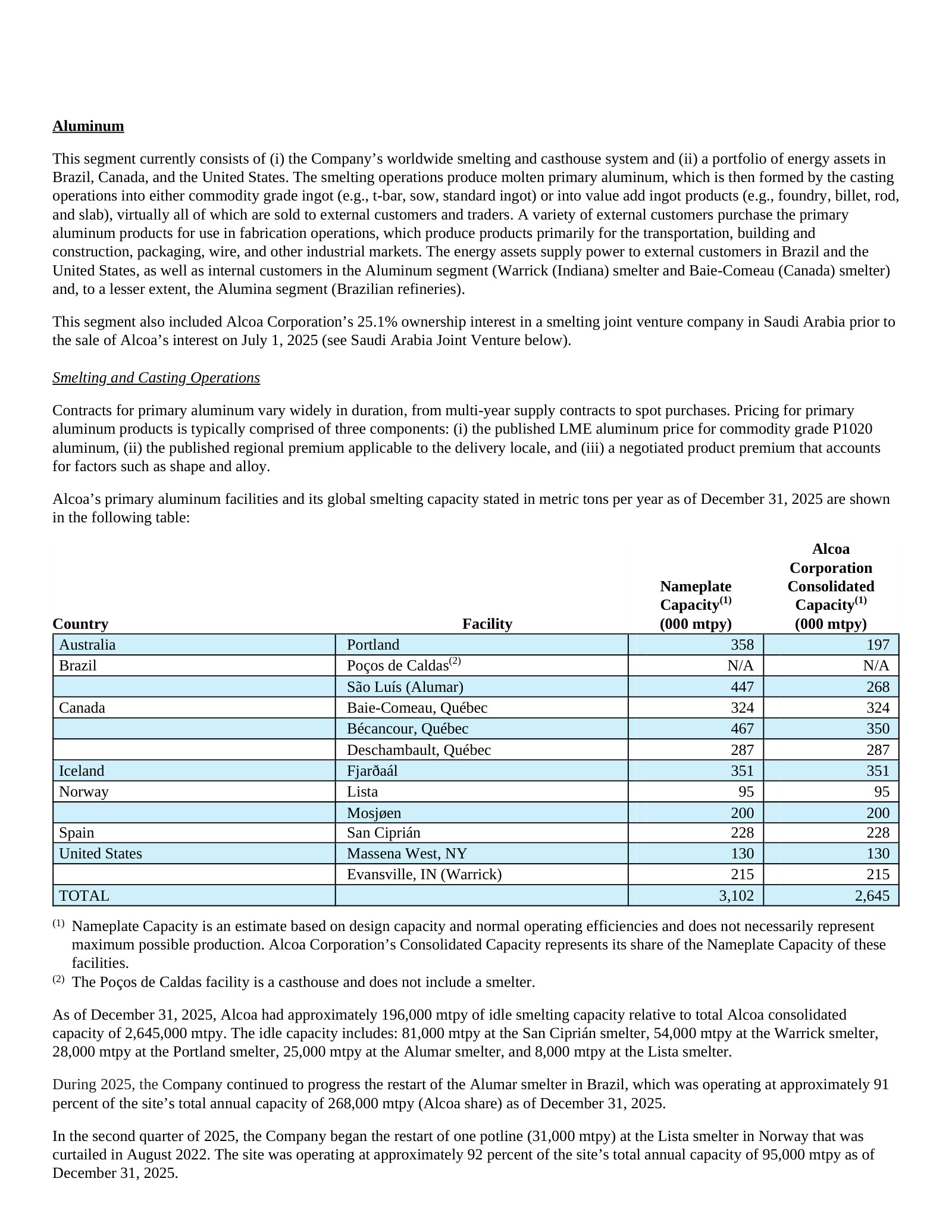
Alcoa Corporation, a Delaware corporation (Alcoa or the Company) which became an independent, publicly traded company on November 1, 2016, is active in all aspects of the upstream aluminum industry with bauxite mining, alumina refining, and aluminum smelting and casting. The Company has direct and indirect ownership of 25 operating locations across eight countries on five continents. […] The Company’s operations are comprised of two reportable business segments: Alumina and Aluminum.
p. 3 · Read in context →
Item 1A. Risk Factors — p. 26 · Read the full section →
The company-specific risks that could genuinely bite: mining-permit renewals (central to the Australia grade story) and tailings/residue impoundment failure.
Mining depends on renewing permits — delays can lower bauxite quality and raise costs (the live Western Australia issue).
Our mining operations are subject to extensive permitting and approval requirements. […] Failure to obtain, maintain, or renew permits or approvals, or permitting or approval delays, restrictions, or conditions has in the past and may in the future impact the quality of the bauxite we are able to mine and could increase our costs and affect our ability to efficiently and economically conduct our operations, potentially having a materially adverse impact on our results of operations and profitability.
p. 30 · Read in context →
Tailings and bauxite-residue impoundments risk catastrophic failure — a physical hazard unique to Alcoa's asset base.
Some of our operations generate waste and other byproducts, which we contain in tailing facilities, residue storage areas, and other structural impoundments that are subject to extensive regulation and increasingly strict industry standards. Failure of storage areas caused by extreme weather events, erosion, or unanticipated structural failure of impoundments could result in severe, and in some cases catastrophic, damage to the environment, natural resources, or property, or personal injury and loss of life.
p. 42 · Read in context →
Item 2. Properties — p. 55 · Read the full section →
Regulation S-K subpart 1300 mining disclosure — the bauxite reserve base and grades that underpin the whole business, rare in an industrial 10-K.
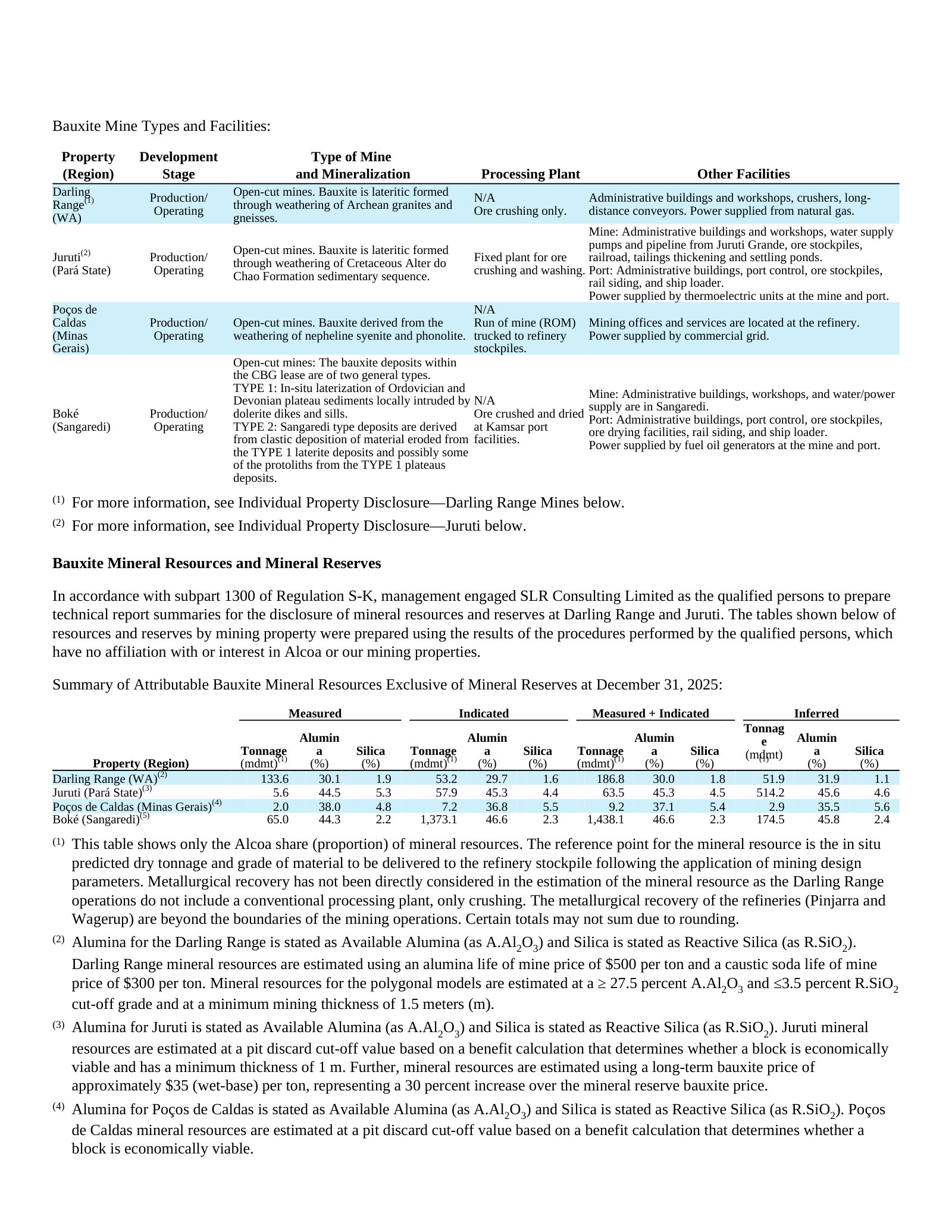
Mining rights at Darling Range and Juruti extend more than 15 years — the resource runway behind the refineries.
Alcoa has access to large bauxite deposit areas with mining rights that extend, in the cases of Darling Range and Juruti, more than 15 years from the date of this Form 10-K. The Company obtains bauxite from its own resources located in the countries listed in the table below, as well as pursuant to both long-term and short-term contracts and mining leases.
p. 55 · Read in context →
Item 7. Management's Discussion and Analysis — p. 80 · Read the full section →
Management's own read on what drove 2025 — price swings, Section 232 tariffs, and the portfolio actions reshaping the company.
Australia mine approvals: a federal strategic assessment through the 2045 lease term, with an 18-month exemption to keep mining.
In February 2026, Alcoa agreed with the Australian federal government to undertake a strategic assessment for all current and potential future mine areas (excluding Myara North and Holyoake) through the term of its existing mine lease ending in 2045 under the EPBC Act. […] The Australian federal government granted Alcoa a national interest exemption that allows Alcoa to continue its mining operations at the Huntly and Willowdale mines for 18 months while the strategic assessment is completed.
p. 84 · Read in context →
Segment Information (within MD&A) — p. 93 · Read the full section →
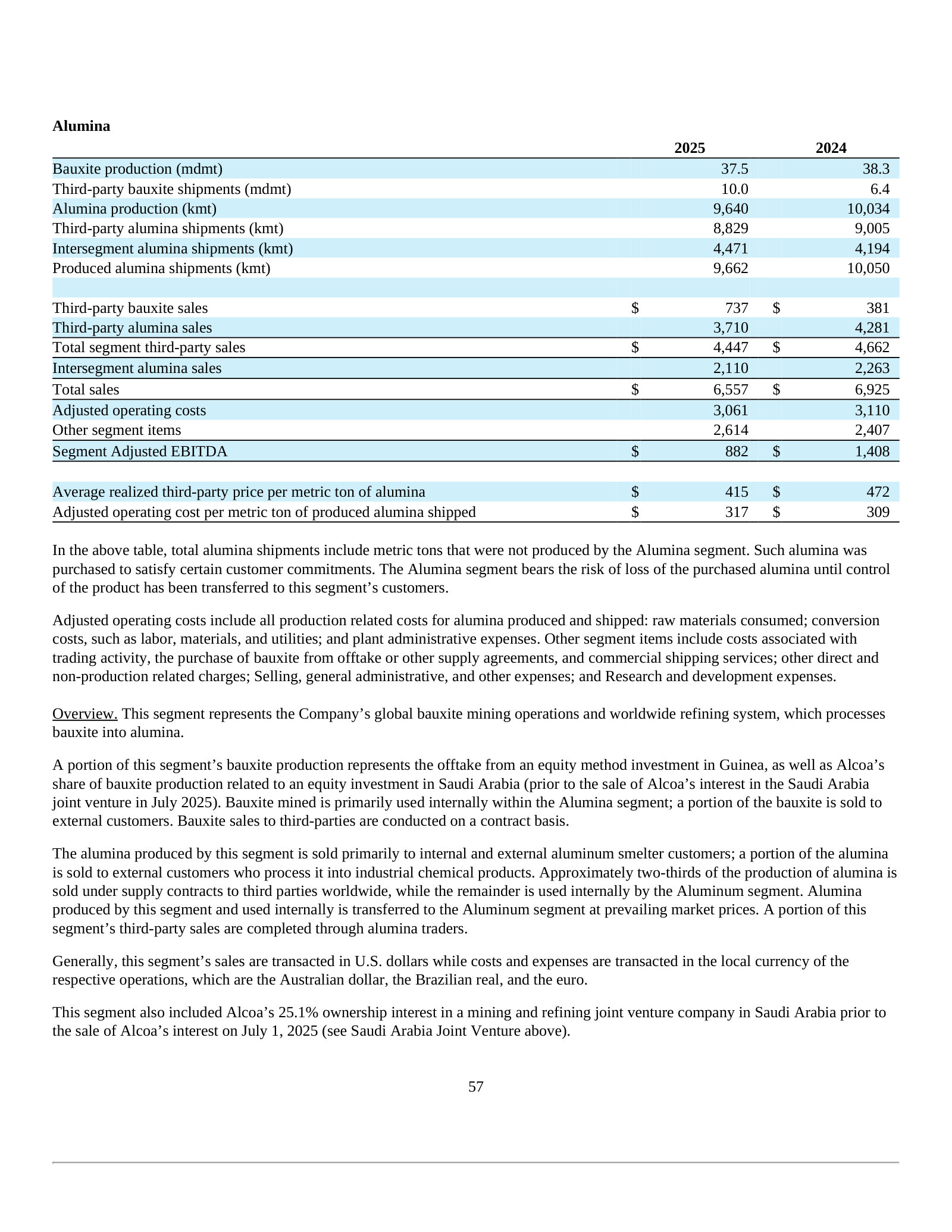
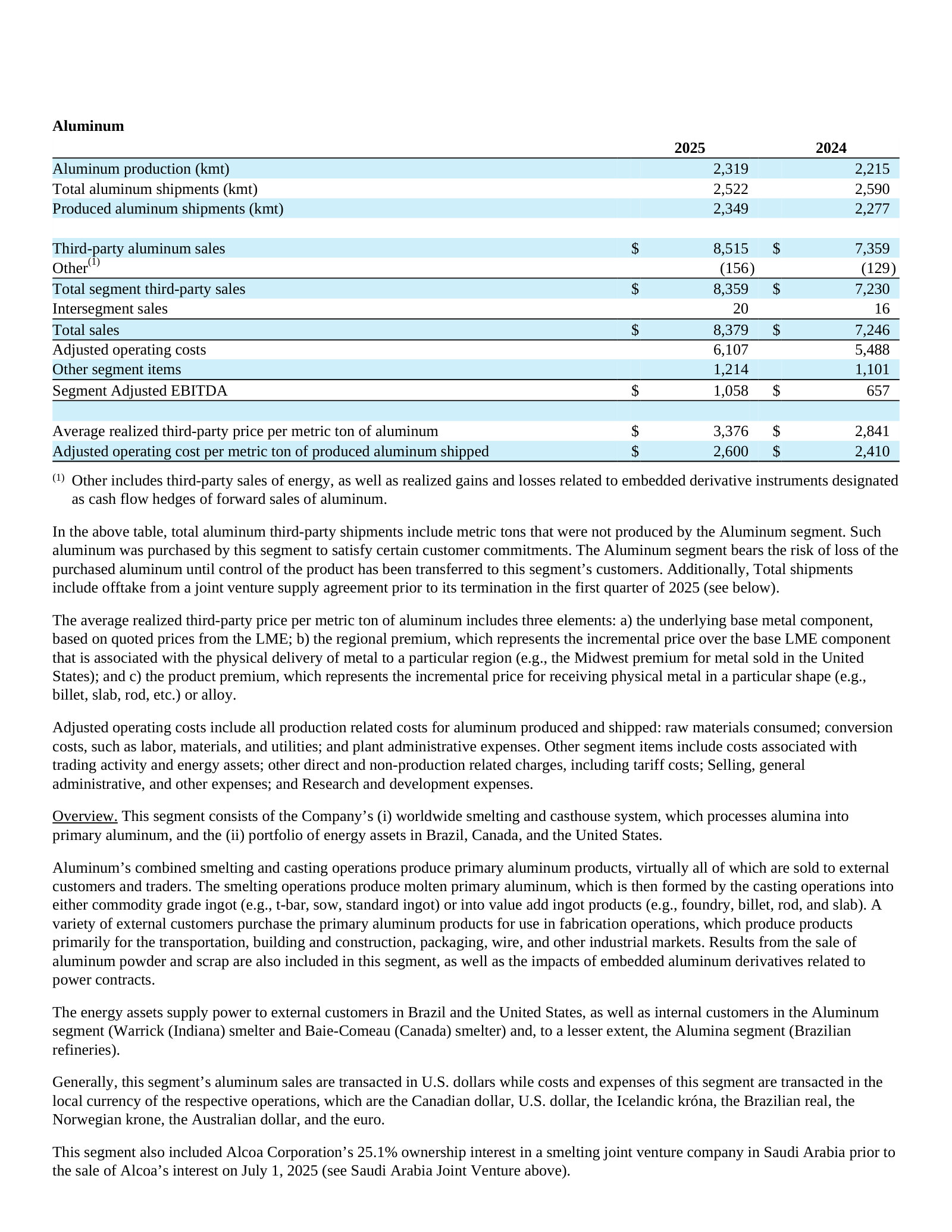
Where management shows how each segment earns — realized prices, unit costs, and the EBITDA split that drove consolidated results.
Report of Independent Registered Public Accounting Firm — p. 121 · Read the full section →
The critical audit matter isolates the accounting that defines Alcoa's economics: mine-reclamation and bauxite-residue retirement obligations.
Critical audit matter: $1,405M of asset retirement obligations for mine reclamation and closure of bauxite residue areas.
As described in Notes B and R to the consolidated financial statements, the Company recognizes asset retirement obligations (AROs) related to legal obligations associated with the standard operation of bauxite mines, alumina refineries, and aluminum smelters. […] As of December 31, 2025, the Company had $1,405 million in AROs, of which $355 million related to mine reclamation and $869 million related to the closure of bauxite residue areas.
p. 123 · Read in context →
Alcoa Corporation — FY2022 Annual Report (Form 10-K) — FY2022
The last 10-K reported under three segments — included here to see the Bauxite segment before it was folded into Alumina in 2023. · Open the full document →
Segment Information — p. 76 · Read the full section →
Shows the pre-2023 three-segment structure and management's own announcement of the redefinition into two segments.
Alcoa announces it will combine Bauxite and Alumina, moving from three reportable segments to two beginning January 2023.
Beginning in January 2023, financial information for the activities of the bauxite mines and the alumina refineries will be combined and the Company will report its financial results in the following two segments: (i) Alumina, and (ii) Aluminum. Accordingly, segment information for all prior periods presented will be updated to reflect the new segment structure in future Quarterly Report on Form 10-Q and Annual Report on Form 10-K filings.
p. 78 · Read in context →
More annual reports
Alcoa Corporation — FY2024 Annual Report (Form 10-K) — FY2024 · 240 pages · First full year of Alumina Limited consolidation and the record Q4 2024 alumina-price spike behind 2025's normalization. · Open →
Alcoa Corporation — FY2023 Annual Report (Form 10-K) — FY2023 · 250 pages · First 10-K under the new two-segment structure, with the San Ciprián and Kwinana curtailment decisions taking shape. · Open →
Alcoa Corporation — FY2021 Annual Report (Form 10-K) — FY2021 · 211 pages · Post-pandemic recovery year with peak aluminum prices — a cyclical high-water mark for comparison. · Open →